
California Lighting Regulations
California regulates the amount of power that exterior lighting on buildings and landscapes can consume.
The California Energy Commission developed regulations that are found in chapter 6 of the California Energy Code.
The California Energy Code regulations apply to all exterior lighting and affect how landscape architects design and specify lighting fixture and equipment.
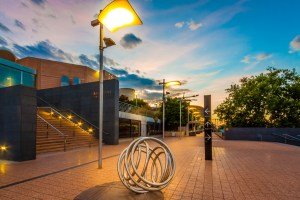
Photo by Ikhwan Zailani Yuslim. Site Design by HDR.
Helpful Guides for Landscape Architects
There are two state-published guides to help landscape architects walk through the maze of regulations:
- Residential Compliance Manual (external link)
- Non-Residential Compliance Manual (external link)
The compliance guides make the California Energy Code easier to understand and provide examples of how the code is applied in the real world.
Helpful Tip for Landscape Architects
I was reading the California Energy Commission’s Non-Residential Compliance manual the other day and came across some suggested notes to include on lighting plans.
Landscape architects typically include notes to clearly communicate with contractors and plan reviewers our design intent and that the design complies will all applicable laws and regulations.
I have added these notes to my Evernote database of lighting comments. I hope you find them helpful as well. The following notes can be found in Chapter 6 of the Non-Residential Compliance Manual.
OUTDOOR LIGHTING CONTROLS AND EQUIPMENT
Outdoor Lighting. All permanently installed outdoor luminaires employing lamps rated over 100 watts shall either: have a lamp efficacy of at least 60 lumens per watt; or be controlled by a motion sensor unless exempted from the 8 possible exceptions. See Section 132
Luminaire Cutoff Requirements. All outdoor luminaires that use lamps rated greater than 175 watts in hardscape areas including parking lots, building entrances, sales and non-sales canopies, and all outdoor sales areas shall be designated Cutoff for light distribution. To comply with this requirement, the luminaire shall be rated Cutoff in a photometric test report that includes any tilt or other non-level mounting condition of the installed luminaire. Cutoff is a luminaire light distribution classification where the candela per 1000 lamp lumens does not numerically exceed 25 at or above a vertical angle of 90 degrees above nadir, and 100 at or above a vertical angle of 80 degrees above nadir. Nadir is in the direction of straight down, as would be indicated by a plumb line. 90 degrees above nadir is horizontal. 80 degrees above nadir is 10 degrees below horizontal unless exempted from the 6 possible exceptions.
Controls for Outdoor Lighting. All permanently installed outdoor lighting shall be controlled by a photocontrol or astronomical time switch that automatically turns off the outdoor lighting when daylight is available unless exempted from the exception. See Section 132(c)
For lighting of building facades, parking lots, sales and non-sales canopies, all outdoor sales areas, and student pick-up/drop-off zones where two or more luminaires are used, an automatic time switch shall be installed that is capable of (1) turning off the lighting when not needed and (2) reducing the lighting power (in watts) by at least 50 percent but not exceeding 80 percent or providing continuous dimming through a range that includes 50 percent through 80 percent reduction unless exempted from the 6 possible exceptions. See Section 132(c)2. This control shall meet the requirements of Section 119(c).
Final Thoughts on Lighting and Energy Conservation in California
I hope you find these notes helpful. Understanding California’s complex lighting and energy requirements can be more than a little confusing at times.
I’ve covered the topic in Pass the CSE for Landscape Architects if you want to learn more about lighting requirements that you may be tested on during the California Supplemental Exam for Landscape Architects.

No related posts.


John is a landscape architect who is currently preparing to take the California Supplemental Exam to become licensed in California. He is currently a licensed professional landscape architect in Georgia and Florida. John graduated from California State University, Pomona with a BSLA degree in landscape architecture in 1997 and has extensive practice experience in residential and commercial landscape design.